On this page
- Single-Phase and Three-Phase Power in Perth
- Why a 7kW Charger Draws About 32 Amps
- What Happens When the House Gets Busy?
- How Dynamic Load Management Works
- See How Much Room Is Left for the Car
- Do You Need the Full 7kW All Night?
- What Changes on a Three-Phase Home?
- Three-Phase Power but a Single-Phase Car
- Does Every Home Need Dynamic Load Management?
- How Do I Know if My Home Is Single-Phase or Three-Phase?
- Questions to Answer Before the Install
- The Bottom Line
- Common Questions
A 7kW home EV charger can draw about 32 amps. A kW, or kilowatt, is how fast power flows, and an amp is how much electricity the wiring carries at once. If your home has the standard 63 amp single-phase supply, one line of power from the street, how does the house run everything else while the car charges?
In many homes, it can. What matters is how much power the house is using at the same time, how the charger is set up, and whether it uses dynamic load management, which turns the charging down when the house needs more.
Western Power's standard supply is 63 amps on single-phase, or 32 amps on each phase of a three-phase home. Existing homes can differ, so an electrician still needs to check what your home actually has.
Single-Phase and Three-Phase Power in Perth
Think of single-phase as one lane of power into the home, and three-phase as three lanes. The supply limit is the most the home can draw at once.
| Supply | What it means | Western Power standard |
|---|---|---|
| Single-phase | One line of power into the home | 63 amps at 240 volts |
| Three-phase | Three lines of power, each with its own limit | 32 amps on each phase at 415 volts |
Existing homes can differ from the standard. Before a charger goes in, the supply, the main switch, the consumer mains (the cables from the street to your switchboard) and the switchboard itself all need checking.
Why a 7kW Charger Draws About 32 Amps
A home charger sends AC power, the kind in your powerpoints, to the car. The car's onboard charger turns it into DC, the kind a battery stores. A car that can take about 7kW on one phase draws roughly 32 amps.
On a 63 amp single-phase supply, that is about half of what the home can draw. The other half is left for lights, the fridge, the TV and the kettle, but how much the house uses changes through the day.
What Happens When the House Gets Busy?
Say the car wants 32 amps while the air-con, the oven and other appliances push the house to 40 amps. Together that is 72 amps, more than a 63 amp supply can carry.
Without anything managing the charger, the car keeps asking for its full 32 amps, and the main breaker or fuse that protects your whole supply could trip. This is where dynamic load management helps.
How Dynamic Load Management Works
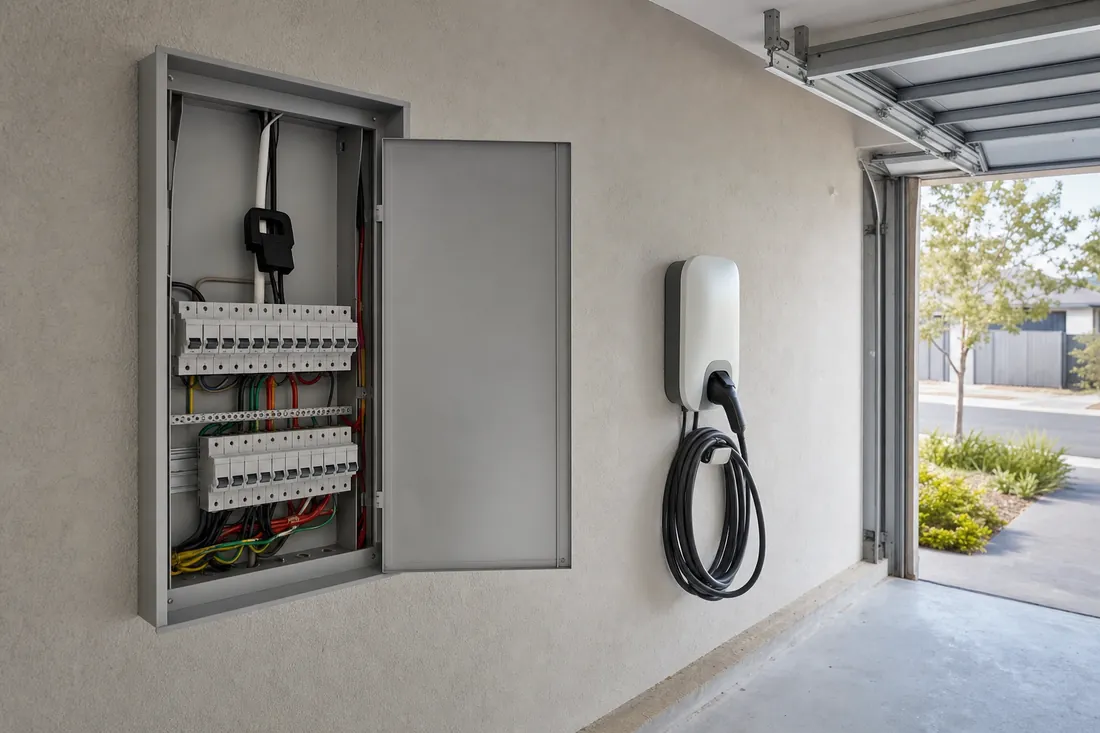
A compatible charger uses CT clamps, small sensors clipped around the main cables in your switchboard, or a meter to see how much the house is using. If the house is using 40 amps, there are about 23 amps left, so the charger turns the car down to fit.
When the dishwasher or the kettle turns off, the charger speeds back up. Our guide to how an EV charging load management system works covers the parts and the set-up in more detail.
Load management protects your home's wiring and supply, and lets the car charge as fast as the spare power allows at that moment.
See How Much Room Is Left for the Car
Pick your supply and how your car charges, then set what the house is using. The results show how much room is left for the car, and what the charger does with and without load management.
How Much Power Is Left for Your Car?
Pick your supply and your car, then set what the house is using. The results update as you go.
An energy monitor or your electricity app may show it. Air-con, cooking and hot water push it up.
Room left for the car
23amps
The car would like 32 amps, about 7kW.
With dynamic load management, the charger turns down to about 5kW for now and speeds back up as the house uses less.
Without it, the house and car together would draw 72 amps against a 63 amp limit, which could trip the main breaker or fuse that protects your whole supply.
This is a simple example, not a check of your home's real limits. Existing homes can differ from the standard supply, and a licensed electrician must check your supply, switchboard and circuits and set any load management limits.
Do You Need the Full 7kW All Night?
If the car gets home at 7pm and leaves at 7am, it has 12 hours to charge. It may not need 32 amps for all of that time. The better question is how much energy the car used today, and how much it needs by the morning.
- How many kilometres do you usually drive in a day?
- How full is the battery when you get home?
- What time do you plug in, and when do you leave?
- Does the car really need to be full every morning?
- Would slower charging while the house is busy make any difference to you?
Our post on whether you need a home EV charger at all has a calculator. It works out how much energy your driving uses in a week, and how long one day's driving takes to put back.
What Changes on a Three-Phase Home?
A standard three-phase supply has 32 amps on each phase. A car with an 11kW three-phase onboard charger usually draws about 16 amps on each of the three phases.
Each phase has its own limit, though. If the air-con, the oven and the washing machine all sit on one phase, that busy phase can run out of room while the other two are lightly used. A charger with phase-aware load management watches each phase and adjusts to the busiest one.
Three-Phase Power but a Single-Phase Car
A single-phase car does not charge on three phases just because the wallbox can. A wallbox is a charger fixed to the wall, and the car decides how many phases it uses.
A single-phase car that charges at about 7kW can ask for roughly 32 amps on one phase. On a standard three-phase supply, that is the whole limit of that phase before the house's own appliances on it are counted.
Having three-phase power does not mean unlimited room for a single-phase car. Load management that watches each phase stops the car competing with the house for more than that phase can safely carry.
Without it, an electrician may set the charger to a lower fixed current, and the car charges more slowly all the time.
Does Every Home Need Dynamic Load Management?
No. Some homes have plenty of spare capacity, and some work fine with a lower fixed charging current. But load management is worth talking about in these cases:
- You want 7kW charging on a single-phase home with big electric appliances.
- You have three-phase power and want 11kW three-phase charging.
- You have three-phase power but your car charges on one phase only.
- You run large air-con, electric hot water, a pool pump or induction cooking.
- You want the fastest charging the home can give, without setting the charger low all the time.
- You expect to add more electric appliances, a second EV or a home battery later.
A lower fixed current can be enough when the car is parked for long nights and doesn't need much each day. The trade-off is that it can't speed up when the house is quiet. Western Power also requires the electrician installing a charger to make sure the supply's capacity isn't exceeded.
How Do I Know if My Home Is Single-Phase or Three-Phase?
There can be clues at the switchboard and meter, but don't open sealed or unsafe electrical equipment to look. An electrician can confirm your supply type and rating safely as part of a charger quote.
Questions to Answer Before the Install
- Is the home single-phase or three-phase?
- What is the real rating of the supply and main switch?
- What AC charging speed can the car take?
- What large appliances does the home run, and when?
- How far does the car usually go each day, and how long is it parked overnight?
- Is solar, a home battery or a second EV in the plans?
- Does the charger support dynamic load management?
- On a three-phase home, how will a single-phase car be managed?
- Does the switchboard have the room, capacity and condition for the charger?
A good charger assessment should answer all of these, and tell you whether switchboard work or a supply upgrade is really needed rather than assumed.
The Bottom Line
A 7kW charger is a big new load, but a typical Perth single-phase home doesn't automatically need three-phase power or a supply upgrade. Look at what the home can really carry, what it uses, and how much charging the car needs.
Before paying for a supply upgrade, have us check your home and car together. The right charger settings or load management may be a simpler way to reliable home charging. All installation is done by licensed electricians.
Common Questions
Can a 63 amp single-phase home run a 7kW EV charger?
Often, yes. A 7kW charger draws about 32 amps, roughly half the supply. If the house can use more than the other half at busy times, dynamic load management turns the charger down so the total stays under the limit.
Do I need three-phase power for an EV charger?
Not usually for a 7kW charger. Many single-phase Perth homes can run one, with load management where the house uses a lot of power. Three-phase power mostly matters if your car can charge at 11kW or more.
Why does a single-phase car need load management on a three-phase home?
A standard three-phase supply has 32 amps on each phase, and a 7kW single-phase car can ask for about 32 amps on one of them. Anything else the house runs on that phase pushes it over, unless the charger turns down.
How many amps does a 7kW EV charger use?
About 32 amps on one phase. An 11kW three-phase charger uses about 16 amps on each of the three phases.