On this page
- Your Solar Was Probably Sized for Your Home, Not Your EV
- What Spare Solar Means
- How a Solar-Aware Charger Knows What Is Spare
- Why Solar-Only Charging Starts and Stops
- Solar With Grid Assist Is the Practical Middle Ground
- You Don't Need a Solar Charger to Use Your Solar
- Work Out What Your Solar Leaves for the Car
- Which Charging Mode Suits You?
- Single-Phase and Three-Phase Homes
- A Note on WA Solar Export Limits
- Is Solar EV Charging Worth It?
- Questions to Ask Before You Buy a Charger
- The Bottom Line
A common question we hear from Perth homeowners is whether solar on the roof means they can charge their car for free.
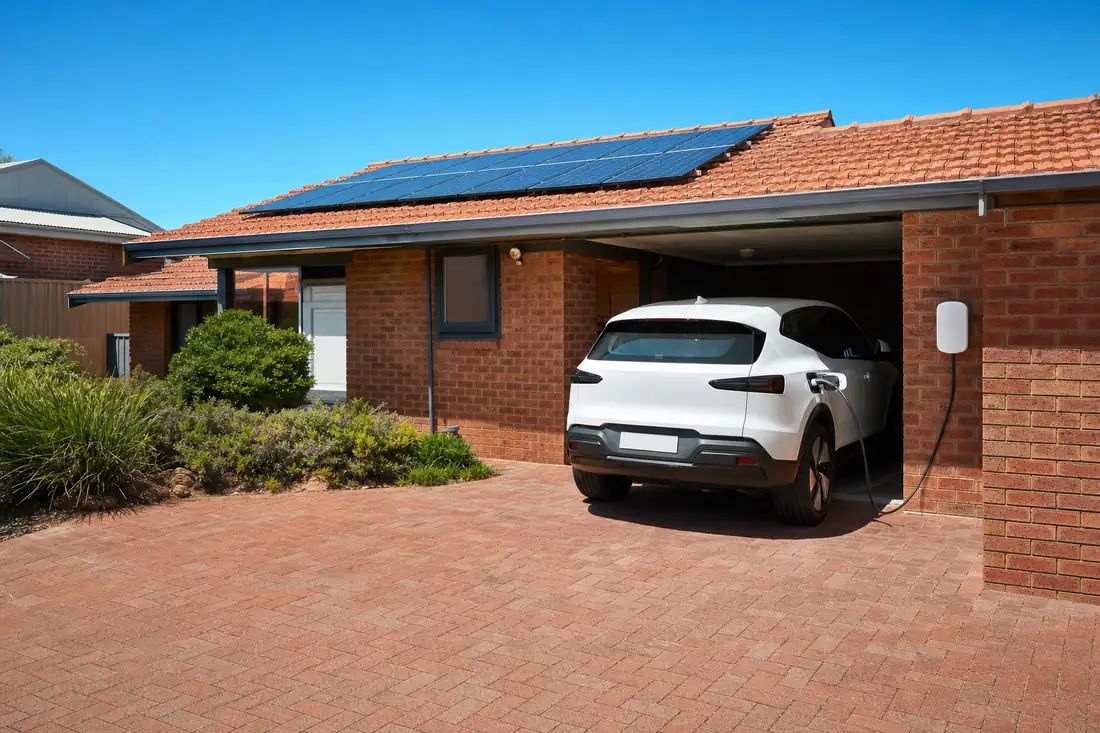
Solar can charge your EV. How much reaches the car depends on how much solar is left once your home has used what it needs.
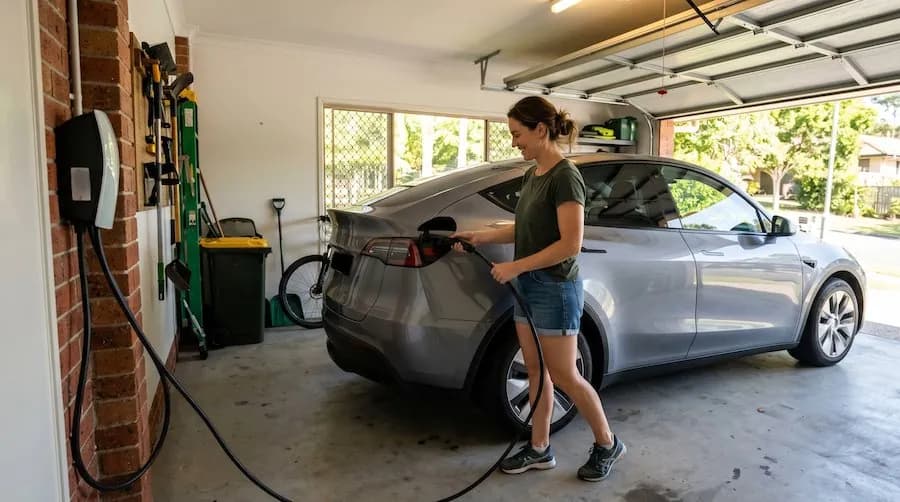
Your EV charger is one more appliance in the home, like the air-con or the pool pump. A solar-aware charger, one that measures your solar and adjusts to it, lets the car's charging follow whatever solar is spare.
Your Solar Was Probably Sized for Your Home, Not Your EV
Many rooftop systems went in before the household had an EV. A common setup is 6.6kW of panels on a 5kW inverter, the box that turns the panels' power into the power your home uses. A kW, or kilowatt, is how much power is flowing at any moment.
That suits normal daytime use, but an EV is a much bigger load. A 5kW inverter can't run a 7kW charger from solar alone, even on a perfect day. If the inverter is making 5kW and the house is using 2kW, about 3kW is left for the car, and the grid supplies the rest.
So the number that matters is the solar left over once the house has had its share, and that is usually well below the size of your panels.
What Spare Solar Means
If the inverter is making 5kW and the house is using 4kW, about 1kW is spare, and depending on your export settings it flows out to the grid. If the panels are making 3kW and the house needs 4kW, the grid supplies the missing 1kW.
Your solar can't tell a kettle from an EV. Both are just loads, things using power, and the house's other loads always take their share first.
How a Solar-Aware Charger Knows What Is Spare
Most solar-aware chargers use CT clamps, small sensors clipped around the main cables where your home connects to the grid, or a compatible meter. They show whether the home is drawing power from the grid or sending spare solar out to it, and the charger speeds up or slows down to match.
Why Solar-Only Charging Starts and Stops
An EV won't charge below a minimum rate. On one phase, meaning one of the supply lines into your home, that is about 6 amps, or roughly 1.4kW. In solar-only mode the charger waits until that much solar is spare, and a smaller system can hover around that line for much of the day.
Turn on the washing machine and the spare solar drops, so the charger may slow down or pause until enough comes back. Your home always comes first in solar-only mode, so this pausing is normal.
Solar With Grid Assist Is the Practical Middle Ground
Some chargers offer a solar-priority or grid-assist mode. The charger uses whatever solar is spare and tops it up from the grid to keep the car charging.
Say only about 0.5kW of solar is spare and the car needs about 1.4kW to charge. The charger takes the 0.5kW from solar and about 0.9kW from the grid. As more solar comes in, the grid's share drops, and once solar can carry the load it can drop to nothing.
You get steadier charging than solar only and still use as much of your solar as you can. Our solar charging package has a Solar Assist mode that works this way.
You Don't Need a Solar Charger to Use Your Solar
This is one of the biggest myths we hear. A standard home charger still uses your solar, because your solar is already powering everything in the home.
Say the car asks for 7kW and about 4kW of solar is spare after the house. Around 4kW comes from solar and the other 3kW comes from the grid.
A solar-aware charger adds control. Solar only keeps grid power to a minimum, and grid assist puts solar first but keeps the car charging. A standard charger still uses your solar, but takes its full rate and lets the grid cover the gap.
Work Out What Your Solar Leaves for the Car
Enter your inverter size and what the house uses during the day to see what is left for the car, and how each charging mode would use it.
How Much Solar Is Left for Your Car?
Set your inverter size and what the house is using during the day. The results update as you go.
It is on the inverter's label or your solar quote. A common older setup is 6.6kW of panels on a 5kW inverter.
Your solar app or meter shows it. Air-con, a pool pump and hot water push it up.
Spare solar at best
3kW
Your 5kW inverter, minus the 2kW the house is using.
How each charging mode uses it
- Solar only3kW from solar
- Solar with grid assist3kW from solar
- Standard 7kW charging3kW from solar + 4kW from the grid
Over 4 hours, solar could put about 12 kWh into the car at most. A kWh, or kilowatt-hour, is 1kW of power for an hour.
This is a best-case snapshot for a clear day with the inverter at full output, not advice for your home. Real output drops with cloud, shade, heat and the time of day, and your car, charger, phases and export settings all change the result. A licensed electrician should set up and check any solar-aware charger.
Which Charging Mode Suits You?
| What matters most to you | Mode | What to expect |
|---|---|---|
| Using as much spare solar as possible | Solar only | Can be slow, or stop and start, when spare solar is low |
| Solar first, but steady charging | Solar with grid assist | Some grid power is used |
| Fast, predictable charging | Standard charging | Solar helps when it is there, and the grid covers the rest |
| Charging on a three-phase home | Set up for your site | Needs the right sensors and phase set-up, checked at install |
Single-Phase and Three-Phase Homes
A single-phase home has one supply line, and a three-phase home has three that share the load. On a single-phase home, solar charging is fairly simple to follow.
Three-phase homes need more care. A car charging on three phases needs the minimum rate on each phase, and a single-phase car on a three-phase home only uses one of them. How your solar, the house's appliances and the charger's sensors are spread across the phases all change what happens.
So don't assume three-phase solar means a three-phase car will charge easily in solar-only mode. The car, inverter, charger and phases need to be looked at together.
A Note on WA Solar Export Limits
An export limit caps how much spare solar your home can send out to the grid. You may have heard that WA homes can only export 1.5kW per phase, but the rules are more involved than that. Western Power currently sets export limits for the whole property, measured at the point it connects to the network, not per phase.
The limit can depend on your site's approval, your retailer and your system's settings, and some systems have a dynamic export limit that can change. An older solar system may not behave like a new one.
For EV charging, what counts is what your system is actually making, what the home is using and what the charger can measure at your place.
Is Solar EV Charging Worth It?
For the right household, yes. Ask yourself:
- Is the car home and plugged in during the sunny hours?
- What size are your panels and your inverter?
- How much power does the house use during the day?
- How much solar is really spare, going by your solar app or meter?
- Is the home single-phase or three-phase?
- Can your car charge on one phase, three phases or both?
- Do you want strict solar-only charging, or solar first with help from the grid?
- How much energy does the car need each week, and how many sunny hours can it stay plugged in?
Many EV batteries hold 60 to 100 kWh (kilowatt-hours), and one kWh is 1kW of power running for an hour. If spare solar averages a few kilowatts for a few hours, putting 30 or 40 kWh into the car takes a long time.
That works well for a car parked at home through the day, and much less well for one that is out during the sunniest hours. Planning to charge on weekends? Check the car will be home and plugged in for three or four good solar hours.
A home battery can carry spare solar into the evening, and our guide to solar EV charging costs and setups covers when a battery is worth adding.
Questions to Ask Before You Buy a Charger
- How does the charger measure spare solar?
- Does it have a true solar-only mode?
- Does it have a solar-priority or grid-assist mode?
- How much spare solar does it need before it starts?
- What does it do when the house suddenly uses more power?
- How does it behave on a three-phase home with a single-phase car?
- Will the installer check the sensors are fitted the right way, matched to the right phases and tested before they leave?
- Can I switch easily between solar charging and full-speed charging?
The Bottom Line
Solar EV charging can work really well when your expectations match your home. The number to watch is how much solar is spare after the house has had its share, at the times the car is plugged in.
A solar-aware charger gives you control over that balance, and a standard charger still uses your solar. Before choosing a charger because it says solar, look at your inverter, daytime use, phases, car and when it is home.
Talk to us about solar EV charger installation and we can help match the charger and mode to the way your home and car really run. All installation and set-up is done by licensed electricians.