On this page
- 1. Spare Home Solar Is Usually the Cheapest
- 2. Charging at Home on Synergy's Home Plan
- 3. Synergy's EV Add On: When You Charge Matters
- 4. Public Charging: You Pay for Speed and Access
- Work Out What Your Week Costs
- Why Public DC Charging Still Makes Sense
- How Long Does 60 kWh Take?
- So What Is the Best Way to Charge?
- Check Your Home Tariff Before You Switch
- Check These Before You Use a Public Charger
- The Bottom Line
- Common Questions
One of the best things about an EV is that you choose where and when you buy its energy. The same 60 kWh can cost close to nothing from spare solar, a few dollars on the right home rate, or many times more at a public fast charger.
A kWh, or kilowatt-hour, is the unit your power bill charges you for. 60 kWh is about a week of driving for many Perth households, such as 300 km at 20 kWh per 100 km.
For most WA drivers, the cheapest energy is spare solar from their own roof, then home charging at the right time of day. Public chargers usually cost more, but you are paying for speed and convenience.
1. Spare Home Solar Is Usually the Cheapest
If the car is home during the day and your solar is making more than the house is using, that spare energy can go into the car. It adds close to nothing to your power bill, although you give up the export credit that solar would have earned going back to the grid.
Solar-only charging can be slow. How fast it goes depends on your panels, your inverter (the box that turns solar power into power the home can use), what the house is using, the car and how long it stays plugged in. Our guide on whether you can really charge an EV from solar works through it with a calculator.
2. Charging at Home on Synergy's Home Plan
Most Perth homes are on Synergy's standard Home Plan, called A1. From 1 July 2026 it costs 33.2621 cents per kWh at any time of day, plus a daily supply charge of 119.2419 cents.
You pay the supply charge whether the car charges or not, so only the price per kWh changes what charging costs. At 60 kWh a week, the car's energy on the Home Plan costs about $19.96 a week, or about $1,038 a year.
3. Synergy's EV Add On: When You Charge Matters
Synergy's EV Add On is a time-of-use plan, which means the price per kWh changes with the time of day. You need an EV or plug-in hybrid registered to your address and an advanced meter, the kind that records when you use power.
| Time of day | Price from 1 July 2026 | 60 kWh a week | A year |
|---|---|---|---|
| 9am to 3pm (super off peak) | 8.8520c per kWh | $5.31 | $276 |
| 11pm to 6am (overnight) | 19.9172c per kWh | $11.95 | $621 |
| 6am to 9am and 9pm to 11pm (off peak) | 24.3431c per kWh | $14.61 | $760 |
| 3pm to 9pm (peak) | 55.3253c per kWh | $33.20 | $1,726 |
The plan also has a daily supply charge of 132.7806 cents, a little more than the Home Plan's.
The catch: these rates apply to everything your home uses, not just the car. Charging in the cheap hours can save a lot, but if the house runs the air-con and oven between 3pm and 9pm, all of that power costs the peak rate.
So before switching, look at what the rest of the home uses in the evening. Our guide to time-of-use tariffs in WA covers how to tell whether one suits your household.
4. Public Charging: You Pay for Speed and Access
There is no single price for public charging in WA. Each station owner sets its own price, and it can change by site, time of day and how long you stay plugged in. Some sites also charge an idle fee if the car sits there after it has finished charging.
Public AC chargers, the slower kind found at shopping centres and hotels, run at 7kW, 11kW or 22kW if your car can take it. A kW, or kilowatt, is how fast the power flows.
The 11kW and 22kW speeds need three-phase power, a supply with three lines instead of one, and a car built to use it. DC fast chargers, the kind on highways, can run at 50kW, 100kW, 150kW or more, and usually cost more per kWh.
Always check the live price in the charging app before you start. RAC members currently get 20% off at RAC's own charging stations through the Chargefox app, and our guide on how to pay at EV charging stations explains the apps and cards.
| Example public price | 60 kWh a week | A year |
|---|---|---|
| 50c per kWh | $30.00 | $1,560 |
| 65c per kWh | $39.00 | $2,028 |
| 80c per kWh | $48.00 | $2,496 |
These prices are examples to show how much the rate changes the total. Use the live station price for a real trip.
Work Out What Your Week Costs
Set how much energy your car uses in a week and the public price you would pay. The results show the cost at each Synergy rate and at the public charger, and how long that energy takes at each charging speed.
What Will Your Car's Charging Cost Each Week?
Set how much energy your car uses in a week and what you would pay at a public charger. The results update as you go.
Kilometres a week times your car's kWh per 100 km, divided by 100. 300 km at 20 kWh per 100 km is 60 kWh.
Each charging network sets its own price. The charging app shows the live price before you start.
Cost of that energy
- Spare solar from your own roofClose to $0
Spare solar costs close to nothing to use, but you give up the export credit it would have earned.
- EV Add On, 9am to 3pm$5.31 a week · $276 a year
- EV Add On, 11pm to 6am$11.95 a week · $621 a year
- EV Add On, 6am to 9am and 9pm to 11pm$14.61 a week · $760 a year
- Synergy Home Plan (A1), any time$19.96 a week · $1,038 a year
- EV Add On, 3pm to 9pm$33.20 a week · $1,726 a year
- Public charger at 65c per kWh$39.00 a week · $2,028 a year
The EV Add On rates apply to everything the home uses in each time band, not just the car.
Time to add 60 kWh
- Portable charger on a powerpoint25 to 33 hours
- 7kW home charger8.6 hours
- 11kW three-phase AC5.5 hours
- 22kW AC, if the car can take it2.7 hours
- 50kW DC fast charger1.2 hours (best case)
- 100kW DC fast charger36 min (best case)
- 150kW DC fast charger24 min (best case)
This compares the energy cost only, using Synergy's published rates from 1 July 2026 and leaving out daily supply charges and charging losses. Public prices are examples, and DC times are simple maths: real DC charging slows as the battery fills, and the car's own limits apply.
Why Public DC Charging Still Makes Sense
A DC fast charger costs more per kWh, but it can add a lot of range while you stop for a break. Home charging is slower, and it works in the many hours the car is already parked.
How Long Does 60 kWh Take?
| Charger | Power | Time to add 60 kWh |
|---|---|---|
| Portable charger on a powerpoint | About 1.8 to 2.4kW | About 25 to 33 hours |
| Home wallbox | 7kW | About 8.6 hours |
| Three-phase AC | 11kW | About 5.5 hours |
| High-power AC | 22kW | About 2.7 hours, if the car can take 22kW |
| DC fast charger | 50kW | About 1.2 hours, best case |
| DC fast charger | 100kW | About 36 minutes, best case |
| DC fast charger | 150kW | About 24 minutes, best case |
The time is just the energy divided by the power. A wallbox is a charger fixed to the wall, and a portable charger is the cable that plugs into a normal powerpoint.
The DC times are the best case. Real DC charging slows as the battery fills, and the car's own charging limit, the battery's temperature and how full it was to start all change the time. Our guide to how long it takes to charge an electric car goes further.
So What Is the Best Way to Charge?
For many Perth EV owners, home charging is the everyday answer and public DC charging is for longer trips or when you need energy fast. If the car is home while your solar is making spare power, use it.
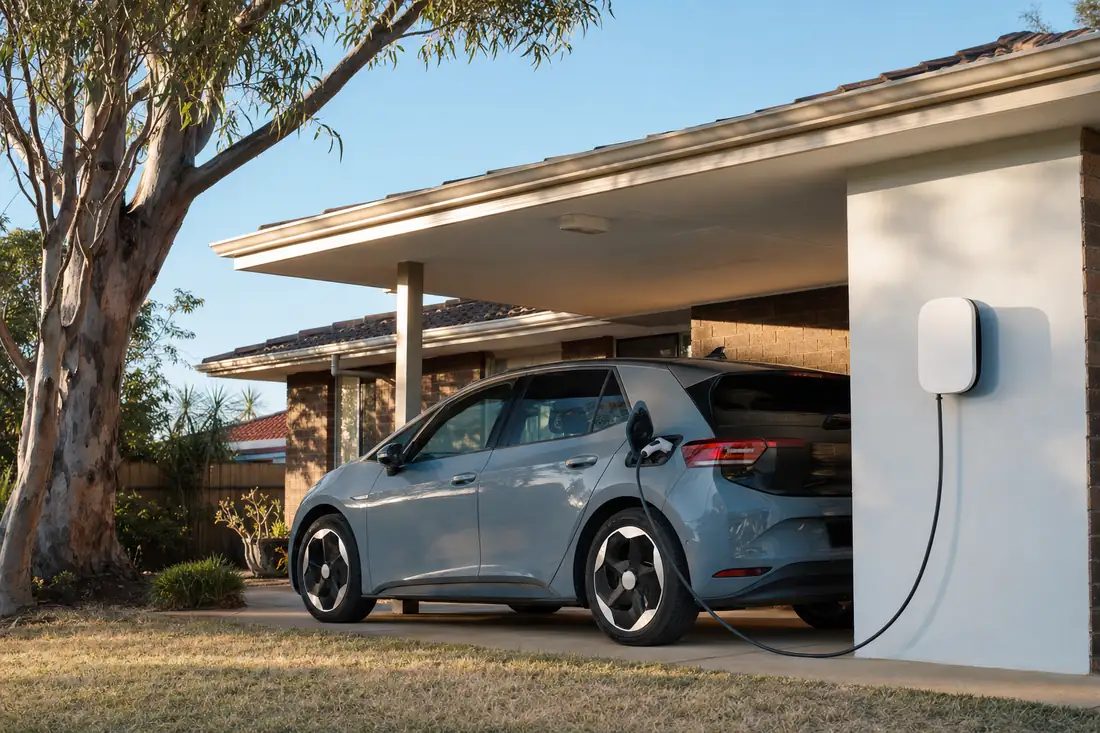
If it isn't, set the car or charger to charge in a cheaper time band your plan allows. A smart EV charger can do that for you, so the car starts charging when the cheap rate begins.
Check Your Home Tariff Before You Switch
- Which Synergy plan are you on now?
- What is the price per kWh in the hours you would charge?
- Would a time-of-use plan change the price of everything else the home uses?
- Can the car or charger start charging automatically at a set time?
- Can the home use less power between 3pm and 9pm?
- Is the car home between 9am and 3pm, when power is cheapest?
- Do you have spare solar in that same window?
Check These Before You Use a Public Charger
- Check the live price per kWh in the charging app before you start.
- Check whether the site charges an idle fee once the car is full.
- Check your car's top DC charging speed, because a 150kW charger does not mean your car takes 150kW.
- Use any membership or motoring club discount you have.
- Pay the higher price when the time you save is worth it.
The Bottom Line
Home charging costs the least, and the car does it while it is already parked. A public fast charger is the quickest way to get back on the road when you need to.
Solar and cheaper time bands bring the cost down further. Our post on the cost of charging your EV at home covers home setup costs, and you can talk to us about a home charger that charges at the right time for your plan.
Common Questions
How much does it cost to charge an electric car in WA?
For 60 kWh a week, about $19.96 on Synergy's standard Home Plan, $5.31 on the EV Add On between 9am and 3pm, or around $30 to $48 at public chargers priced at 50 to 80 cents per kWh. Spare solar costs close to nothing.
What is Synergy's EV Add On?
It is a time-of-use plan for homes with an EV or plug-in hybrid registered to the address. From 1 July 2026 power costs 8.8520 cents per kWh from 9am to 3pm and 55.3253 cents from 3pm to 9pm, and those rates apply to everything the home uses.
Is public charging more expensive than charging at home?
Usually, yes. Each station owner sets its own price, so check the app before you charge. You are paying for speed, and a DC fast charger can add a lot of energy in a short stop.
How long does it take to charge an electric car at home?
Adding 60 kWh takes about 8.6 hours on a 7kW home charger, and about 25 to 33 hours on a portable charger plugged into a normal powerpoint.